
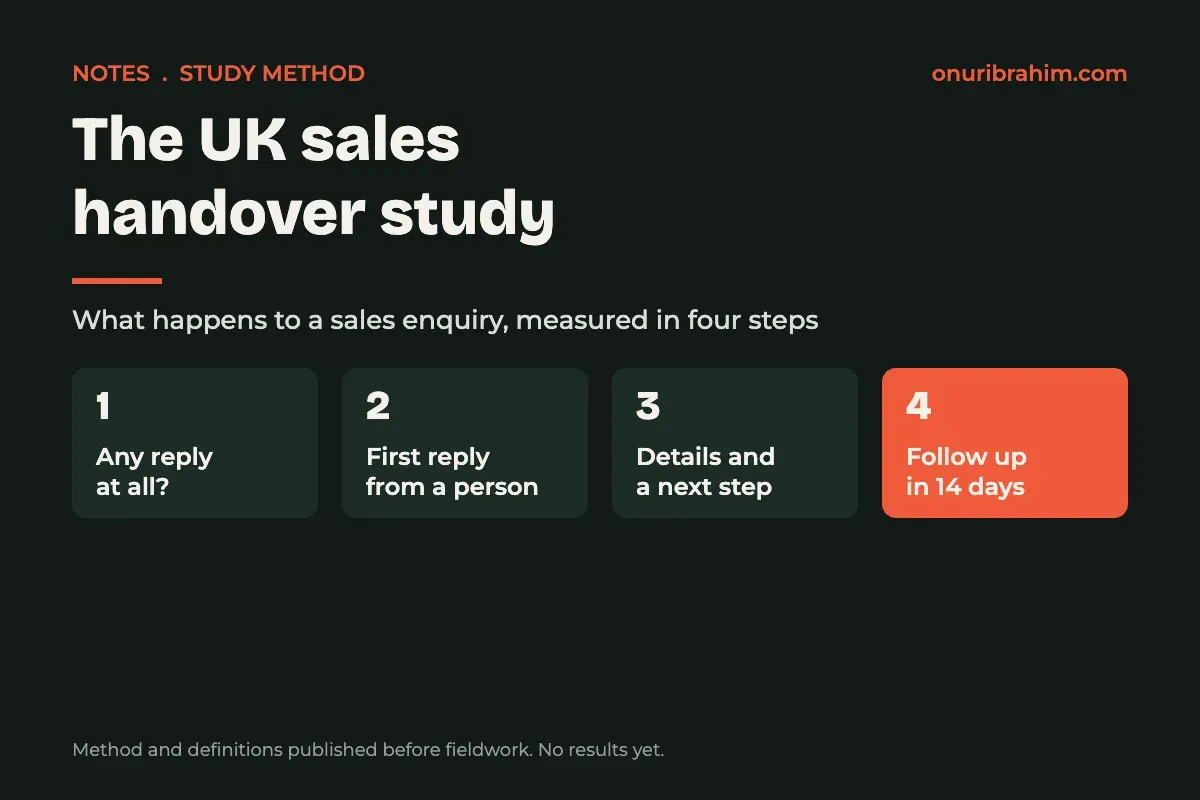
The UK Sales Handover Study: Method and Definitions
By Onur Ibrahim. Published 31 October 2026.
Status: method published, fieldwork not yet started. There are no results on this page yet. I'm publishing the method first so anyone can check how the study works before they see what it finds. The results will be added here when the fieldwork is done.
Why I'm running this study
Published UK research on how businesses handle sales enquiries is patchy. It's mostly one sector at a time, often several years old, and usually run by companies selling a fix.
When I reviewed what exists, the clearest pattern was that very few businesses follow up after their first reply. But I couldn't find a study that tested this across UK service businesses in general. And few looked at the handover, where an enquiry passes from whoever receives it to whoever is meant to move it forward.
This study is meant to fill that gap, with a sample and measures I publish in full.
The questions it answers
What share of UK service businesses reply to a written sales enquiry at all?
How long does the first useful reply from a person take, in business hours?
Does the first reply ask for the details needed to move forward, and suggest a next step?
If the enquirer goes quiet after that reply, does the business follow up, how often and for how long?
Do the answers change with business size, sector, or whether the enquiry arrives during or outside office hours?
Definitions
These are fixed before any data is collected, so they can't be bent to fit the results.
Term | What it means in this study |
|---|---|
Enquiry | One message sent through the business's main website contact form, or to its published email address if there's no form. |
Reply | Any response received by email, phone or text within 14 days. |
Automatic acknowledgement | A response sent by a system without a person reading the enquiry. Recorded separately and never counted as a personal reply. |
First response time | Time from the enquiry to the first useful reply from a person, counted in business hours. |
Business hours | 9am to 5:30pm, Monday to Friday, not counting UK bank holidays. |
Next step | A specific proposed action, such as a call at a stated time, a meeting, a quote with a deadline, or a link to book. |
Details captured | The reply asks for a phone number, availability or another detail needed to move the enquiry forward. |
Follow up | Any further contact the business starts after its first personal reply, while the enquirer hasn't replied. |
Visible handover | The reply shows the enquiry has passed from one person or team to another, for example a reply from a different named person. |
How the study works
The sample
Active UK service businesses drawn from Companies House, in a small set of sectors such as professional services, agencies and business services. Each needs a website with a contact form or a published email address. Businesses are picked at random within each sector. Anyone I've worked with, or am talking to about work, is left out. I'll publish the final sample size, sectors, size bands, dates and exclusions with the results.
The enquiry
Every business gets the same short enquiry, changed only to name their service. It describes a realistic need with a rough budget and timeframe. It includes an email address but no phone number, so I can see whether the business asks for one. The exact wording will be published with the results.
Timing
Half the sample gets the enquiry mid morning on a Tuesday, Wednesday or Thursday. The other half gets it in the evening on the same days, to see how out of hours enquiries are handled. Which business gets which slot is decided at random.
Watching what happens
Nobody gets a reply from me for 14 days. That's how I can see whether a business follows up on its own. After 14 days, every business that replied gets a short thank you that closes the enquiry.
Recording
Every response is logged with its time, channel and sender. Two people code each reply against the definitions above without seeing each other's answers, and I'll report how often they agreed.
What gets reported
The share of businesses that replied at all, and the share that sent only an automatic acknowledgement.
The median first response time and its range. The median, not the average, because one very late reply would distort an average.
The share of first replies that captured details and suggested a next step.
The share that followed up, how many times, and after how many days.
Differences by sector, size and time of day, where the numbers are big enough to mean something.
Results will show links between things, not causes. Any group smaller than ten businesses won't be reported on its own. Missing or unclear data will be stated, not filled in.
Limits I already know about
One enquiry per business. A single test shows how one enquiry was handled on one day, not how a business usually performs.
Written enquiries only. Phone calls, live chat and walk ins aren't tested.
A test enquiry isn't a real buyer. Some businesses may judge it as low value and treat it that way, as they would a real one.
Sector and size limits. The results will apply to the sectors and sizes sampled, not to every UK business.
I sell the fix. I help businesses improve how they handle enquiries. That's why the method, wording and anonymised data will all be published, so others can check the work.
Ethics and data
Each enquiry is short, and every thread is closed at the end, so no business spends more than a few minutes on it. No business will be named. I record only the business name, sector, size band and the content and timing of replies. Personal details of the staff who reply are removed before analysis, and the raw records will be deleted once the results are published and checked.
Run the same check on your own business
You don't need to wait for the results. Ask a friend to send your business the kind of enquiry a new customer would, once in office hours and once in the evening. Then don't let them reply for two weeks. Write down when the first personal reply came, whether it asked for their details, whether it offered a next step, and whether anyone followed up.
If the answers surprise you, bring them to a free first hour. We'll look at where your enquiries go quiet and who should own the next step. You can also see the ways I can help with sales follow up.
How to cite this method
Ibrahim, O. (2026) The UK sales handover study: method and definitions. onuribrahim.com, 31 October 2026. Please cite the results only once they're published on this page.
