
Where UK Businesses Lose Sales After the First Enquiry
By Onur Ibrahim. Published 31 October 2026. Sources checked 31 October 2026.
This is a review of other people's published research, with my reading of it. None of the figures below are my own data. Each one sits beside who measured it, when, on what sample, with a link to the original.
In short
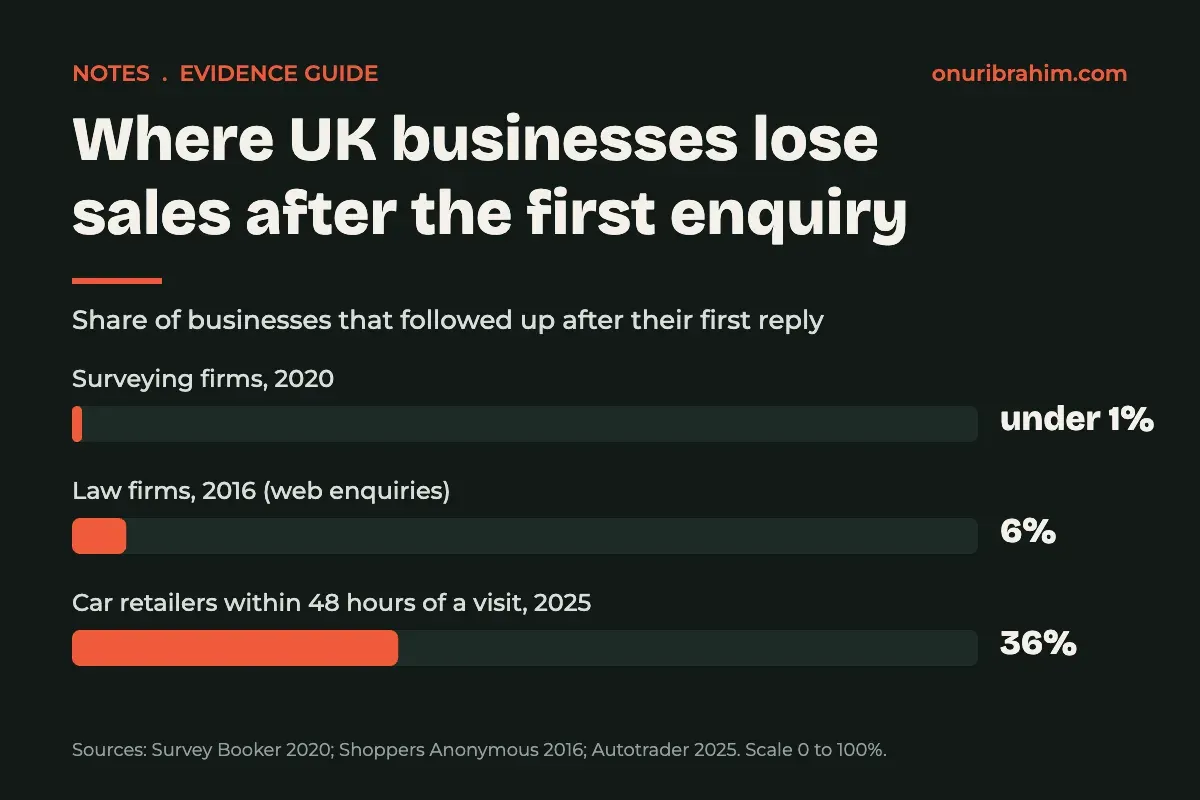
Most of the talk about lost enquiries is about speed. The UK evidence points somewhere else. Across the published mystery shops I could check, the weakest point is not the first reply but what happens after it. Between about one in eight and one in three businesses tested never replied at all, and among those that did, follow up after the first contact was rare: under 1% of surveying firms tested in 2020, 6% to 7% of law firms tested in 2016, and 36% of car retailers after a forecourt visit in 2025.
Definitions
The studies use slightly different words for the same stages, so I use four terms throughout.
Enquiry: a first approach from a potential customer by website form, email, phone, portal lead or visit.
First response: the first human or automated reply the enquirer gets. Where a study separates automatic acknowledgements from personal replies, I say which.
Follow up: any further contact the business starts after its first response, without being chased.
Handover: the point where an enquiry passes from whoever received it (marketing, reception, a portal, an inbox) to whoever is meant to progress it (sales, a fee earner, a negotiator).
Finding 1: a meaningful share of enquiries get no reply at all
In every UK mystery shop I found with a stated result, some businesses never answered a written enquiry. The share runs from about one in eight to one in three, depending on sector, channel and how the test was run.
15.9% of 132 UK surveying firms sent no response to an emailed quote enquiry. Source: Survey Booker, Lead Response Study, 2020, enquiries by email or contact form. Vendor research. Original study
About a third of emails sent to hospitality venues in the UK and Ireland got no reply. Source: Stampede, fieldwork spring 2023, published 17 May 2023. One question sent to "hundreds" of venues, mostly restaurants and bars; exact count not given. Vendor research. Original study
12% of car retailers did not respond by email or phone, and 18% did not answer the email enquiry. Source: Autotrader Insight, published 24 October 2025. Annual mystery shop of the top 1,000 retailers on its platform. Original study
39% of estate agents were reported as not replying promptly to a sales enquiry, and 30% of lettings enquiries got no reply. Source: Homeflow, published 19 September 2023. Sample size not stated, and the page is unclear on whether the 39% means a slow reply or none, so treat it with care. Vendor research. Original study
Finding 2: first replies are slower than buyers will wait
Where businesses do reply, about half or fewer manage it within an hour in the UK tests I found. Buyers, by their own account, give far less time than that on the phone and expect a written reply within a day.
What businesses deliver
46.9% of surveying firms replied within an hour, and 9.8% within five minutes. Source: Survey Booker, 2020, 132 firms.
The average estate agent reply to a sales enquiry took 229 business minutes, almost four working hours, and only half of the agents who replied did so within an hour. Source: Homeflow, September 2023.
22% of hospitality venues replied within an hour and 60% within 24 hours. Source: Stampede, May 2023.
Fewer than half of car buyers' enquiries were answered within an hour. Source: Autotrader Insight, October 2025.
What buyers say they expect
37% of UK adults say they would give up on an unanswered business call within 60 seconds and contact a competitor. Only 6% would leave a voicemail instead. Source: YouGov for Answer4u, online survey of 2,046 UK adults, fieldwork 5 to 8 June 2026. Commissioned by a call answering company, and a stated intention rather than observed behaviour. Press release
85% of UK home sellers expect an agent to reply to a first enquiry within 24 hours, and one in five think anything over four hours is too slow. Source: Street Group, survey of 1,830 current and recent sellers via Find Out Now, 15 June 2026. Vendor research. Original study
Finding 3: follow up after the first contact is where most enquiries are dropped
This is the clearest pattern in the UK evidence and the least talked about. Where a study measured whether the business came back after its first response, very few did. Plenty of enquirers are not ready to decide on day one, so a business that replies once and stops is relying on the buyer to chase.
Fewer than 1% of surveying firms followed up after their first reply. Source: Survey Booker, 2020, 132 firms.
Law firms followed up 6% of website enquiries, 7% of phone enquiries and 7% of walk in enquiries. Source: Shoppers Anonymous, The client journey project, reported by Legal Futures on 24 May 2016. 85 firms, more than 400 mystery shopper contacts. An older study, but still the most detailed UK legal example I found. Report
Only 36% of car retailers tried to follow up within 48 hours of a forecourt visit, falling to 31% of small and 15% of medium sized retailers. Source: Autotrader Insight, October 2025. This was measured after a visit, which is later in the journey than a first enquiry.
Only 1 in 5 professional services firms followed up after first contact, and 42% did not reply within two days. Source: Moneypenny with insight6, reported by Accountancy Age on 13 March 2026 from figures shared at an industry event. No sample or method was published, so this is the weakest source here. Report
Finding 4: the first reply often does not move the sale forward
A reply can arrive on time and still lose the sale if it answers the question and stops. Several studies looked at what the reply said, and the common gap is that businesses do not ask for the next step or capture the details they would need to follow up.
Fewer than 15% of hospitality venues that replied tried to take a booking, and fewer than 5% sent any automatic acknowledgement. Source: Stampede, May 2023.
When law firms replied by email, 86% of mystery shoppers would have welcomed a live conversation, but one happened only 25% of the time because firms did not ask for contact details. Source: Shoppers Anonymous, 2016.
26% of car retailers made no attempt to capture a visitor's contact details, and only 62% of email replies acknowledged the specific request. Source: Autotrader Insight, October 2025.
Finding 5: the causes reported are organisational, not technical
The researchers who explained their results mostly pointed to ownership and process rather than missing software. Stampede listed inboxes still forwarding to people who had left, nobody owning the inbox, and tools that were not connected, so staff replying had no record of the customer. Shoppers Anonymous reported that firms often judged enquiries too small or felt too busy. The authors of the 2011 Harvard Business Review audit, as summarised by Reply Intelligence Group, gave similar reasons: leads pulled from systems once a day, teams focused elsewhere, and unclear rules on who handles what.
What the famous speed figures do and do not show
Two American studies sit behind almost every speed to lead claim, and they are often mixed up. They are worth citing correctly because a careful reader will check.
The 2011 Harvard Business Review article by James Oldroyd, Kristina McElheran and David Elkington reported an audit of 2,241 US companies sent a test web enquiry. 37% replied within an hour, 16% within one to 24 hours, 24% took longer than a day and 23% never replied. Among those that replied within 30 days, the average was 42 hours. A separate analysis of 1.25 million leads at 42 US companies found firms that tried to make contact within an hour were nearly seven times as likely to qualify the lead as firms that tried an hour later.
The often quoted "21 times" and "100 times" figures come from an earlier piece of work, the 2007 Lead Response Management Study by InsideSales.com and James Oldroyd, based on six companies and more than 15,000 leads. It compared calling within five minutes with calling within thirty. It did not measure whether the customer bought.
Both studies are American, more than a decade old and involved a sales software vendor. They show a link between speed and qualification, not proof that speed alone causes sales. I use them for direction, not for a precise multiplier. The HBR article is paywalled, so I checked its figures against two independent summaries.
What this means for a UK service business
This section is my own reading of the evidence above, drawn from my work on sales, marketing, CRM and agency handovers. It is not a finding of any study.
Reading the studies together, I see four separate places where a sale can leak, and most businesses only measure the first.
Gap 1: nobody owns the enquiry
The enquiries that never get a reply are rarely ignored on purpose. They land in a shared inbox, a portal, or the form notification of someone who has moved role. If no named person is responsible for each new enquiry, some will fall through, and nobody will know how many.
Gap 2: the first reply arrives after the buyer has moved on
Buyers often contact more than one business at once. A reply the next morning is competing with whoever answered the same evening. An automatic acknowledgement that says when a person will be in touch costs almost nothing, and it was missing from most of the hospitality replies tested.
Gap 3: the reply answers the question but does not ask for the next step
Answering the question and stopping leaves the buyer to do the work. The reply should capture what you need to continue (a phone number, a date, a budget) and offer one clear next step. Even who the reply comes from matters, which I look at in should your email come from a business or a person.
Gap 4: nobody comes back after the first contact
This is where the UK evidence is most consistent and where I think most value is lost. It is also usually the handover point. Marketing or reception has done its job by passing the enquiry on, and whoever receives it has no rule for when to chase or how often. Fixing it is mostly a written rule, a reminder in the CRM and someone checking the numbers every week. Knowing when to keep chasing and when to stop is its own skill, which I cover in the power of a pause, and the experience loop maps the wider journey from first contact to repeat work.
How to check your own business
You can measure your own version of these figures in an afternoon with last month's data. Pull every enquiry from your CRM, inbox and portals into one list, then record for each one:
Whether it got any reply, and who sent it.
Minutes from enquiry to first personal reply, counting business hours. Use the median rather than the average, because one very late reply distorts an average.
Whether the first reply captured contact details and proposed a next step.
Whether anyone followed up when the enquirer went quiet, and after how many days.
What happened to it in the end: won, lost or unknown.
The "unknown" count is often the most useful number. It is the size of the gap between the enquiry and the follow up.
Method
I searched for published research measuring how UK businesses respond to sales enquiries: mystery shops, consumer surveys and platform data. I included a study only if I could open the original page or a report of it and find who ran it, when, on what sample and how. I read each source in full rather than relying on search snippets or other people's statistics roundups. US studies are included only for context and are labelled as such. Every figure was checked against its source on 31 October 2026. Where a source did not state something, such as a sample size, I say so rather than estimate it.
Limits
Most of the evidence is vendor research. Survey Booker, Stampede, Homeflow, Answer4u, Street Group and Moneypenny all sell products that address the problem they measured. Their data is real, but they chose what to test and what to publish.
The samples are sector specific: surveyors, hospitality, car retail, estate agency and law. I could not find a published study covering UK service businesses in general.
The studies are not comparable with each other. They used different channels, questions, time windows and definitions of a reply. I show them side by side to reveal a pattern, not to calculate an average.
Some are old. The legal study is from 2016 and the surveying study from 2020. I kept them because they are the only UK studies I found that measured follow up directly, and the pattern matches newer data.
Survey answers are stated intentions, not a measurement of what people actually do.
None of this measures lost revenue directly. It shows where enquiries stall. What that costs depends on the business.
Figures I left out, and why
Several statistics appear widely in articles about missed enquiries. I did not use them because I could not trace them to a source with a published sample and method. These include an estimate that UK businesses lose around £30 billion a year to missed calls, the claim that 85% of callers who reach voicemail never call back, the claim that 78% of customers buy from the first business to respond, and a figure of 391% higher conversion when leads are called within a minute. Some may be accurate. I could not verify them, so they are not here.
Sources
Source and who measured it | When and sample |
|---|---|
Lead Response Study 2020 | 2020. 132 UK surveying firms. |
The hospitality industry is leaving money in their inbox | Spring 2023. Hundreds of UK and Ireland venues. |
39% of Sellers Wait for an Agent's Response | September 2023. Estate agents, size not stated. |
Lessons from the Latest Mystery Shop | October 2025. Top 1,000 car retailers. |
The client journey project | May 2016. 85 law firms, 400+ contacts. |
The £1.3m Missed Call Problem | March 2026. Sample not stated. |
One in Three UK Consumers Will Call a Competitor | June 2026. 2,046 UK adults. |
Home sellers have a 24-hour patience threshold | June 2026. 1,830 UK home sellers. |
The Short Life of Online Sales Leads | March 2011. 2,241 US companies (US context). |
Speed to lead: what the research actually says | October 2026. Summary of the 2007 and 2011 studies. |
All sources opened and checked on 31 October 2026. I review this note every six months.
How to cite this note
Ibrahim, O. (2026) Where UK businesses lose sales between the first enquiry and the follow up. onuribrahim.com, 31 October 2026. If you quote a figure, please also name the original source and year shown beside it. I compiled these figures; I did not produce them.
Want to know where your own enquiries stall?
Bring the problem as you see it. In the first hour we will talk through what happens to your enquiries today and where I would start. Book your free first hour, or see the ways I can help with your sales follow up and the people handling it.
