FREE GUIDE FOR FOUNDERS THINKING ABOUT SELLING
Part of you wants out. Part of you feels guilty for it.
The business is doing fine. People rely on you. And still, you're tired of carrying all of it. Before You Sell helps you work out what you really want, make the business less reliant on you, and choose the right buyer, whether you sell next year or never.
Work out if you want to sell, or just want a different job
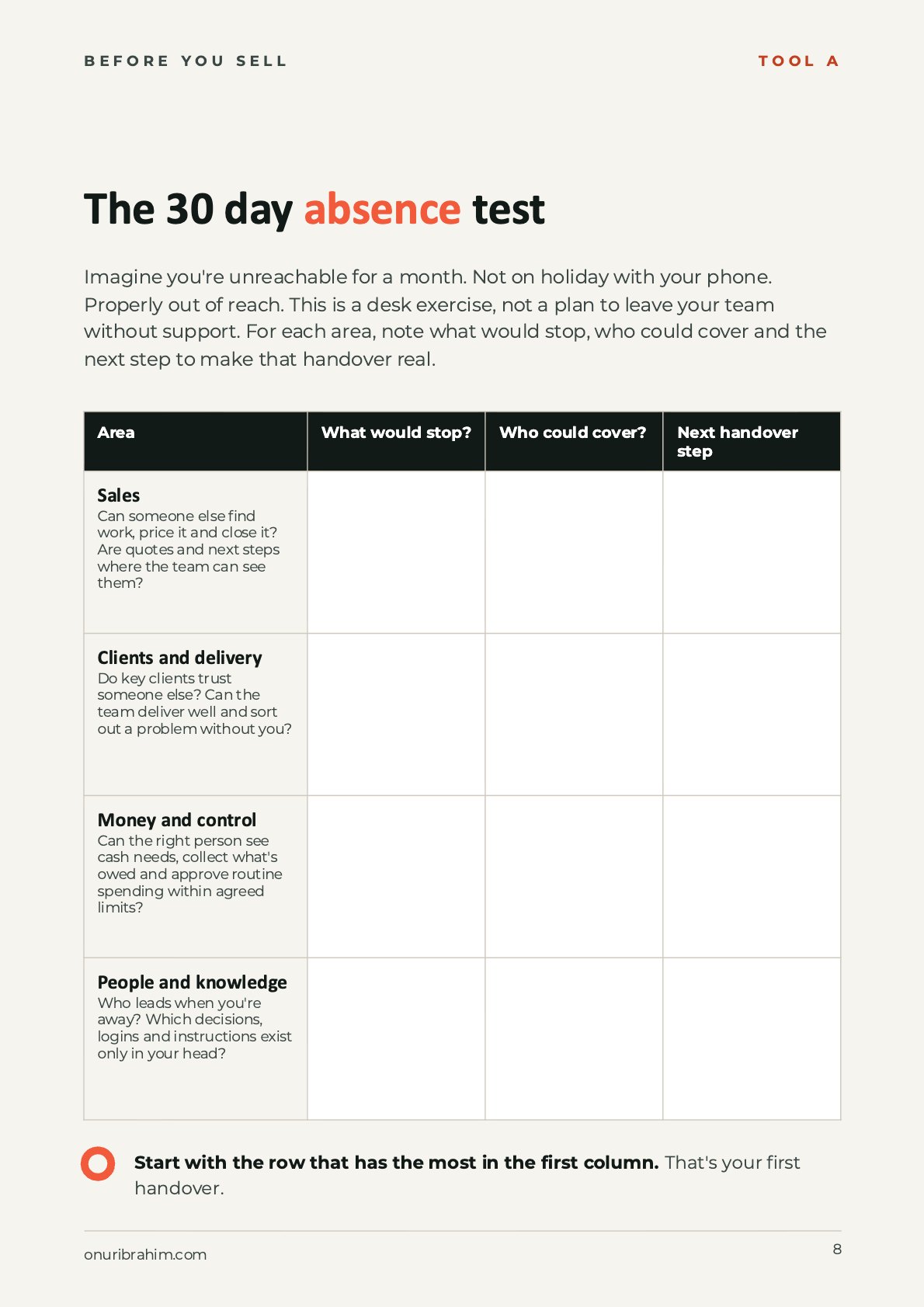
Find what still depends on you with the 30 day absence test
Protect what matters most: your team, clients and name
15 questions to ask anyone who wants to buy your business
Plan what comes next, and your next 90 days on one page
I wrote this because I've stood where you're standing. Three times. No pitch. No pressure.
What happens next
- The free PDF arrives in your inbox in about 7 minutes.
- No call to book, and no need to decide whether to sell.
- Over the next two weeks I'll send five short emails on using the guide. You can unsubscribe whenever you like.
Do I need to be ready to sell?
No. The guide starts with what you want, which might be a sale, a different role in the business, or neither. Most of the work makes the business stronger whatever you decide.
What happens after I download it?
Read it in any order and write on the worksheets. The emails that follow each pick up one question from the guide. If you'd like to talk it through, there's a free First Hour, but you never need it.
Will you contact me about buying my business?
Only through the few emails you'll get after the guide. One of them explains that I buy businesses, and you're welcome to reach out if you'd like to talk. I won't chase you to sell, but I'm always happy to have the conversation.
SEVEN QUESTIONS. FOUR TOOLS.
What's inside the guide
15 pages written from the founder's seat, not across the table. Seven questions to work through in any order, and four worksheets you can actually write on. Most of this work makes the business stronger, whatever you decide.
15 pages. Seven questions. Four practical tools.
Seven questions
What do I want to change?
Which route could fit?
What still depends on me?
What matters beyond the deal?
Who should I trust with it?
What will I still be responsible for?
What comes next?
Four tools to write on
The 30 day absence test
A handover priorities sheet for team and clients
15 questions to ask anyone who wants to buy
Your next 90 days on one page
WHY I WROTE THIS
I've stood where you're standing
I've sold three businesses of my own since 2007. Each time, the hardest part wasn't the numbers. It was the quiet stuff nobody puts in a spreadsheet. Wondering if I was letting people down. Feeling oddly guilty for wanting my life back. Not knowing who I'd be on the Monday after.
I've taught martial arts for 35 years, and it teaches you that the person who looks calmest is usually the one who prepared most. Exits work the same way. The founders I've seen leave well, with their people looked after and their name intact, didn't get lucky. They started thinking about it early, honestly, and on their own terms.
That's what this guide is for. Not to push you towards selling, just to help you think clearly before anyone else is in the room. Whatever you decide, you'll have a stronger business for having asked the questions.
Onur
WHAT OWNERS FEEL
You can want out and still care deeply
Mixed feelings aren't a sign you're not ready. They're a sign you're taking it seriously. These are other owners in their own words. They aren't reviews of this guide. They're here so you know these feelings are normal.
Duty and freedom
"I haven't had the freedom to just walk away in decades."
Laura Zander, after selling Jimmy Beans Wool
My change, their jobs
"I am so anxious about telling them."
An owner of 95 staff, selling after 20 years
Relief and the unknown
"A mix of relief, excitement, and a whole lot of uncertainty."
An owner describing life after selling
Sources: Laura Zander, interviewed by 21 Hats, republished August 2026. The other two are from public owner discussions on UK Business Forums and Reddit, 2024 to 2026.
Wanting out doesn't mean you've stopped caring. Usually it means you've cared for a very long time.
ONUR
Where I stand
Here's the honest bit. I buy established UK businesses, so one day I might be a buyer you speak to. I'd rather you knew that now. It's also why every page tells you to get advice from people who act only for you, because that's what I'd want in your seat. Nothing in here is legal, tax or financial advice. But if something in it feels familiar, I'd genuinely like to hear about it.