
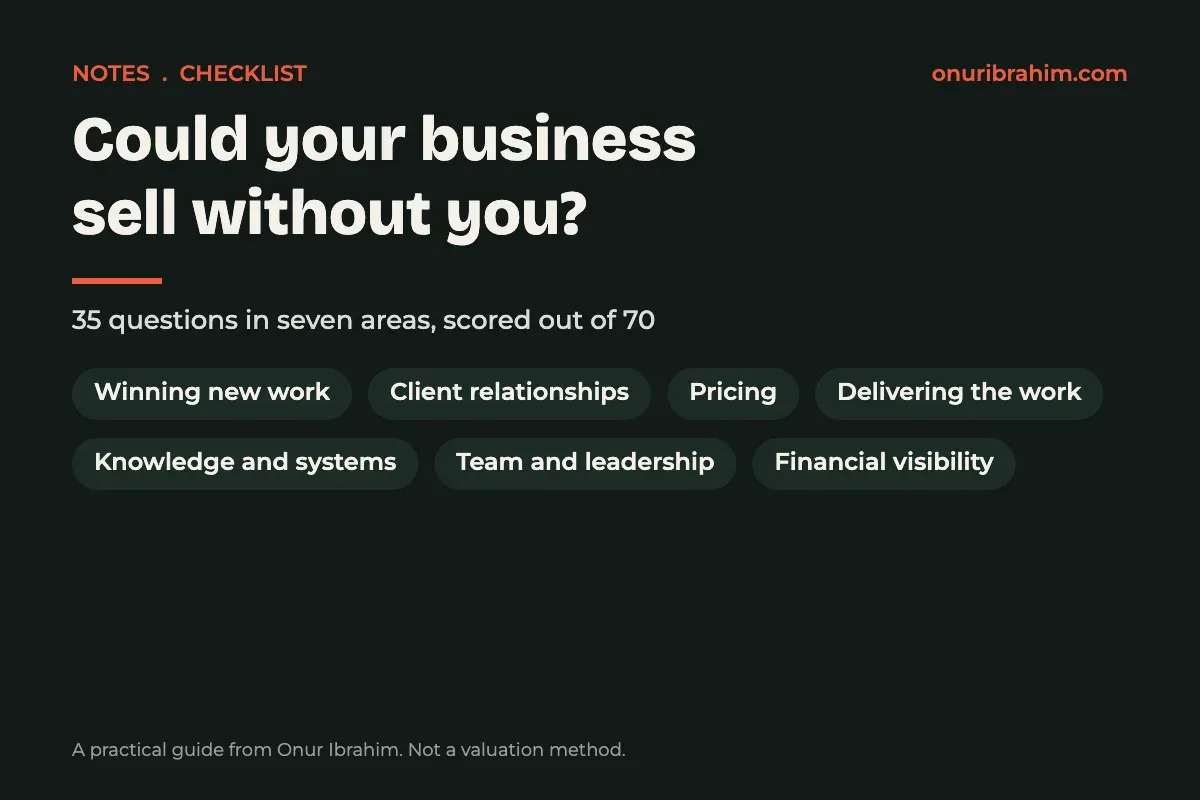
Could Your Business Sell Without You? A Founder Checklist
By Onur Ibrahim. Published 31 October 2026.
A practical checklist from my own work with owner led businesses. It is a guide to where you depend on yourself, not a valuation method.
Why this matters
A buyer, investor or successor wants to know one thing above most others. Will the revenue still be there when you step back? In a lot of owner led service businesses the honest answer is "only partly". The owner wins the work, holds the key relationships, sets the prices and knows where everything is.
That isn't a criticism. It's how most good businesses start. But it's worth knowing where it sits, because the fix takes time. And a business that runs without you is better to own whether you sell or not.
This checklist helps you find where the dependency sits. It takes about 15 minutes. Answer for how things work today, not how they should work.
How to score it
For each question, answer Yes, Partly or No.
Yes means it's true today and someone could prove it. Score 0.
Partly means it's true sometimes, or only in your head. Score 1.
No means it isn't true. Score 2.
Each area scores out of 10 and the whole checklist out of 70. A higher score means the business leans on you more.
1. Winning new work
Does at least one other person regularly win new clients without you in the room?
Is every live opportunity in a CRM or shared system, with its stage, value and next step?
Is there a written process for handling a new enquiry, from first reply to proposal?
Could someone else write and price a proposal to your standard?
Do more than half of new clients come from channels that don't rely on your personal network?
If every new client meets you before they sign, the pipeline stops when you do. Enquiry handling is often the weakest part, which I look at in where UK businesses lose sales after the first enquiry.
2. Client relationships
Does each of your largest clients have a day to day contact who isn't you?
Would your top five clients stay if you were unavailable for three months? Answer as the client would.
Are client contracts held by the business, current and readable by someone else?
Is renewal or upsell handled by someone other than you?
Does every single client account for less than a fifth of revenue?
The last question is a rule of thumb, not a fixed line. Relying on one client is a separate risk from relying on you, but buyers look at both.
3. Pricing and commercial decisions
Are prices and discount limits written down?
Can someone else approve a standard quote without asking you?
Do you know the margin on each main service from records rather than memory?
Are supplier and partner terms held by the business, not agreed on a handshake with you?
Could a buyer see why your prices are set where they are?
4. Delivering the work
Is your core service delivered to a written standard?
Do you spend less than a day a week doing client work yourself?
Is quality checked by someone other than you?
Are problems with clients sorted out without you stepping in?
Could a new team member learn the job from what's written down, plus a few weeks of shadowing?
5. Knowledge and systems
Are passwords and logins held in a shared system the business controls?
Are key processes written down somewhere the team actually uses?
Are the domain, website and email controlled by the business, not a personal account?
Could someone find any client file or past proposal in under five minutes without asking you?
Is the CRM kept up to date by the people who use it, without you chasing?
6. Team and leadership
Is there someone who could run the business day to day for three months?
Do people make decisions within clear limits without checking with you?
Do your key people have fair contracts, incentives or a reason to stay after a sale?
Do team meetings and reviews still happen when you're away?
Would your team describe the business's goals the same way you would?
7. Financial visibility
Do you get monthly management accounts within a few weeks of month end?
Is revenue reported by client and by service, not only as a total?
Is there a forecast that someone other than you keeps up to date?
Are personal and business costs fully separate?
Could your accountant or finance lead answer a buyer's first round of questions without you?
Buyers adjust for anything that's mixed together, and it slows down their checks.
Reading your score
Score | What it usually means |
|---|---|
0 to 17 | Low dependency. The business mostly runs on systems and people other than you. Keep the evidence ready, such as reports, documents and CRM records, because a buyer will ask to see it. |
18 to 38 | Moderate dependency. Common in owner led businesses. Start with the area that scored highest. It's usually winning new work or client relationships. |
39 to 70 | High dependency. The business would struggle if you stepped away for three months. That's fixable. But it often takes a year or more of steady change before it shows in the numbers a buyer looks at. |
These bands are a practical guide from my own experience. They aren't a valuation method, and a buyer or adviser will judge dependency in their own way.
Where to start
Fix the area with the highest score first. Within it, start with the questions you answered No.
In most service businesses I see, the quickest wins are in sales. Write down how enquiries are handled. Put every opportunity in a CRM someone else can read. Then let a second person run part of the sales process while you watch. These changes also leave a record, so a buyer can see them.
If you're thinking about selling or stepping back
My free guide, Before You Sell, takes this further. It has seven questions and four tools for planning the handover and choosing the right route. Question three asks what still depends on you, and this checklist is a good way to answer it.
Or bring your score to a free first hour. We'll look at where the dependency sits and what I'd change first.
