
Answer Engine Optimisation: How to Get Found by AI
By Onur Ibrahim. Published 6 November 2026.
What happens when your next customer asks ChatGPT for help instead of searching Google?
They might ask which company can solve their problem. They might ask which service is best. Or they might ask an AI tool to compare three firms and pick one.
And that AI tool might answer without the customer ever visiting your website.
This is why Answer Engine Optimisation, or AEO, matters.
For years, the aim of SEO was to get your website near the top of Google. That still matters. But now there's another challenge.
Your business needs to be understood and trusted by the tools that give people answers.
The good news is that you don't need to rebuild your site. You need to make it easier to find, easier to understand and more useful to the people you want to reach.
What is Answer Engine Optimisation?
Answer Engine Optimisation is the process of helping AI tools find, understand and use your website when answering questions.
These tools include ChatGPT Search, Google AI Overviews, Google AI Mode, Perplexity and Microsoft Copilot.
Traditional SEO helps your website appear in search results. AEO aims to help your business appear in the answers themselves.
Generative Engine Optimisation, or GEO, is a closely related term. It focuses on how AI systems select, use and cite information.
In practice, much of the work is the same.
You need good content, a clear website, real proof and a strong reputation.
And that last point is important. AI tools can look beyond what you say about yourself.
Why AEO matters more than ever
The numbers show that the way people use search is changing.
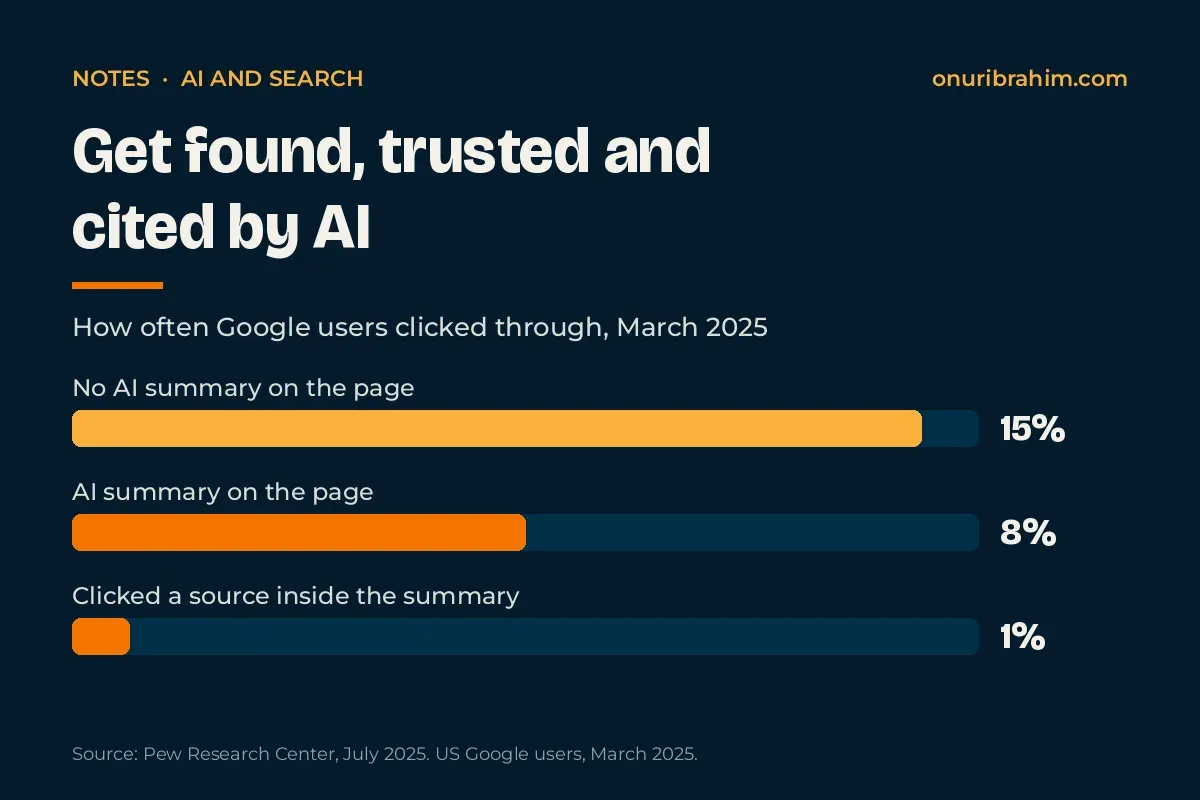
In July 2025, Pew Research Center published a study of Google search behaviour in the United States.
It found that people clicked a normal search result in just 8% of visits when an AI summary appeared.
When there was no AI summary, that figure was 15%.
And only 1% of visits with an AI summary led to a click on a source within that summary.
This was a study of US users in March 2025, so we can't assume the same figures apply to every market.
But the pattern matters.
People can get the answer they want without leaving the search page.
Then, in February 2026, Ahrefs published an updated study based on 300,000 search terms.
Its analysis found that the presence of Google's AI Overviews was linked to a 58% lower average click rate for the top organic result.
That is an estimate based on observed data, not proof that AI caused the whole decline.
Still, it raises an important question.
What happens to your business when someone gets the answer without clicking your link?
Your content needs to do more than attract visitors. It must help people recognise your business as a credible source of advice.
1. Start with the questions your customers really ask
Most websites are written around the services a company wants to sell.
A marketing consultant might have a page called "Marketing Strategy Services".
But the business owner looking for help may be asking something quite different.
"Why am I spending more on marketing but getting fewer sales?"
Or:
"How do I know if my marketing agency is doing a good job?"
The second type of question tells us much more about the problem.
Pew's research also found that 60% of searches starting with question words, such as what, why and how, produced an AI summary.
For searches of ten words or more, 53% produced one.
That doesn't mean adding questions to every page will make you appear in AI answers.
It means the questions people ask are a useful place to start.
What to do: Speak to your customers. Look through sales calls, emails and enquiries. Write down the questions they ask before they buy.
Then make sure your website answers those questions in plain English.
2. Give the answer before the sales pitch
A lot of websites make people work too hard to find out what they need.
There is a big headline, a vague promise and several paragraphs about the company.
But no clear answer.
Imagine someone asks:
"Why do my sales leads go cold?"
A useful page might begin with:
"Sales leads often go cold because replies take too long, follow up stops too soon or the next step is not clear. Check how fast your team responds, how often they follow up and where people stop replying."
That's an answer.
You can then explain each cause, show how to check it and give an example.
A reader gets value at once. An AI system also has clear information it can use.
Make each important page easy to follow. Use one main topic, clear headings and short paragraphs. Add practical steps and examples.
You don't need to use a fixed word count or break every sentence into a separate block.
The goal is to make the answer clear.
3. Build real proof into your content
This is where many businesses have a problem.
They say they're experienced, trusted, innovative or results driven.
But what does that actually tell anyone?
Compare these two claims.
"We help businesses get more leads."
And:
"We reviewed a firm's sales process, found that enquiries were not getting timely replies and changed how the team handled them. Here is what we measured before and after."
The second is more useful because it shows the work behind the claim.
A good case study should explain the problem, what changed, how long it took and what happened.
It should also say what you measured.
Leads are not sales. Quotes are not revenue. And revenue is not profit.
The distinction matters.
You can protect client names while still sharing a real example. You just need to be clear about what the evidence proves.
What to do: Pick three projects where you have sound records. Turn them into case studies with real figures, clear dates and honest limits.
An example from my own work
I've seen this pattern many times, from a luxury Caribbean timeshare rental business to luxury members' clubs. Plenty of leads, very few sales. Someone visits a members' club and dines in the restaurant. That tells you they're interested and probably want to come back. Then member services don't call them for a week.
In one case the owner told me the problem was marketing. They believed in their offer and knew exactly who their ideal customer was and what problems that customer had. So we built a proposition around it and took it to market. It brought in hundreds of leads, and they couldn't close a single one.
When I sit down with a business like that, I don't start with the marketing. I start with the process. What happens when someone enquires? What's the onboarding like? Is there excellence in the customer experience? In B2B and high value sales, trust is the number one factor. Nobody offers a guarantee at that level, so the buyer is quietly asking why they should do business with you, whether you're established and whether they'll get value for money.
What I usually find is a founder trying to do everything. They're handling the sales and the follow up themselves, so calls get missed or never made. They lean on PDFs and digital follow up when someone enquiring about something worth £10,000 or more wants a phone call. They're not going to read the PDF.
One campaign we ran for an education establishment generated 200 leads. It took them a week to call those leads back, and they were about to stop the campaign. So we offered to do some telemarketing for free, called each new lead within 10 minutes of it coming in and booked four appointments. Those people were given a date to view the school. Then the school cancelled and never came back to them with a new date, so they never got their viewing.
That's the real lesson. Things that aren't measured tend not to happen. Most founders watch the big numbers and miss the small ones that tell the truth: how many conversations you're having, how many people move from one stage to the next and what percentage make it through each step. And if trust isn't built first, nothing else will work.
4. Get other trusted websites talking about you
Your website is only one source of information about your business.
AI search tools can also find news articles, interviews, podcasts, videos and other public sources.
And the research suggests these outside mentions matter.
In December 2025, Ahrefs studied 75,000 brands across ChatGPT, Google AI Mode and AI Overviews.
It found a strong positive link between brand mentions on YouTube and AI visibility, with a correlation of about 0.737.
Brand mentions across the web also showed correlations between 0.66 and 0.71.
By contrast, the number of pages on a website had a far weaker correlation of 0.194.
Correlation does not prove cause. Larger brands may naturally attract both more mentions and more AI visibility.
But the result gives us something useful to think about.
Publishing more pages is not the same as building more trust.
A good podcast interview, an expert article or a useful video can add more to your public reputation than another ten generic blog posts.
The aim isn't to get mentioned everywhere. It's to appear in places your customers already trust.
5. Build depth around what you know
Imagine two websites.
One has fifty short articles covering a random mix of business topics.
The other has ten detailed articles showing how to solve a specific set of sales problems.
Which one gives a business owner more useful help?
The second has a better chance of showing real knowledge, provided the content is sound.
For example, a website about improving sales could have one main guide explaining why enquiries fail to turn into customers.
That guide could link to articles about response times, poor follow up, sales handovers, weak offers and pipeline management. My own research on where UK businesses lose sales after the first enquiry is one piece of that picture.
Each article answers a different question. Together, they give a fuller picture.
Google's own guidance on helpful content says websites should have a clear purpose and show real knowledge.
So focus on the subjects you genuinely understand.
And make it easy for readers to move between related pages.
6. Make sure AI tools can read your website
Great content is little use if search tools cannot reach it.
Start with the basics.
Your site needs working pages, a clear sitemap, correct page titles and sensible internal links.
Check that your main pages can be indexed. Make sure old or duplicate pages don't compete with the pages you want people to find.
Then check your robots.txt file.
This tells crawlers which parts of your site they may access.
OpenAI uses a crawler called OAI-SearchBot to help make websites available in ChatGPT Search. It has a separate crawler called GPTBot for model training.
You can choose how to handle them.
You should also make sure your firewall isn't blocking the crawlers you want to allow.
And check that important information can be read as text, not just seen in an image or hidden behind a feature a crawler cannot use.
Google's official guidance is clear. You do not need special AI markup to appear in AI Overviews or AI Mode.
Good technical SEO remains the starting point.
7. Use schema, but don't expect miracles
Schema is a way of helping search engines understand what a page contains.
It can identify a person, company, article or service.
For example, a page about you can provide details about your professional identity. An article can identify its author and publication date.
This helps make the content clearer to machines.
But there is no evidence that adding schema alone will make ChatGPT recommend you.
Google says there is no special schema required for its AI search features.
So use structured data to describe what is true and visible on your pages.
Don't add fake reviews, awards or claims just because a tool lets you.
8. Stop chasing AI shortcuts
As AEO grows, so do the promises.
Some people suggest creating hundreds of AI written articles. Others recommend adding special text files or filling pages with questions.
Google's 2026 guide to generative AI search warns against relying on these tricks.
It says standard SEO, useful original content and a good user experience remain the foundation.
It also states that Google Search does not use special files such as llms.txt to decide whether content appears in its AI features.
That doesn't mean every new technique is useless.
It means you should ask for proof before spending money on it.
Can someone show a measured improvement? Was it tested properly? Did it bring better customers or just more mentions?
If the answer is unclear, keep your money.
9. Measure whether AI is helping your business
This is the part I think matters most.
Being mentioned by ChatGPT feels good.
But it won't pay the bills on its own.
You need to track what happens next.
Start by writing down twenty real questions your customers might ask AI tools.
Test them in ChatGPT Search, Google and Perplexity. Record whether your business appears, whether your website is cited and whether the description is accurate.
Repeat the test each month.
AI answers can change from one search to another, so don't treat a single result as proof of success.
You can also use Bing Webmaster Tools AI Performance to see which pages are cited in supported Microsoft AI answers.
Then check your website data.
Are the right people visiting? Are they enquiring? Are they booking calls? And are those calls turning into work?
I would rather have five suitable enquiries than five thousand AI mentions that lead nowhere.
Where should you start?
You don't need to change everything at once.
I would start with five things.
Check access. Make sure your best pages can be found and read.
Find real questions. Use what your customers ask, not just keyword tools.
Improve your best pages. Give clear answers with useful steps and proof.
Build your reputation. Share original work and earn genuine mentions from trusted sources.
Measure the result. Track citations, visits, qualified enquiries and sales separately.
Do those things well before publishing another pile of articles.
The real goal of Answer Engine Optimisation
AEO is not about finding a trick that makes ChatGPT say your name.
It's about making your business easier to understand, easier to verify and easier to trust.
And it goes beyond AI.
When you answer real questions, show real work and explain what makes you useful, you make the buying decision easier for people too.
That's the part worth getting right.
Because being found is one thing.
Being understood, trusted and chosen is what grows a business.
I help business owners work out what is holding back their sales and marketing results. Sometimes that means fixing the plan. Sometimes it means improving the team or agencies doing the work. And sometimes it means getting the work done.
If you're busy but growth is stuck, book your free first hour. We can look at what's happening and work out what makes sense to fix first.


